Stop Collecting, Start Curating: How to Build an Instrument Arsenal That Actually Makes Sense
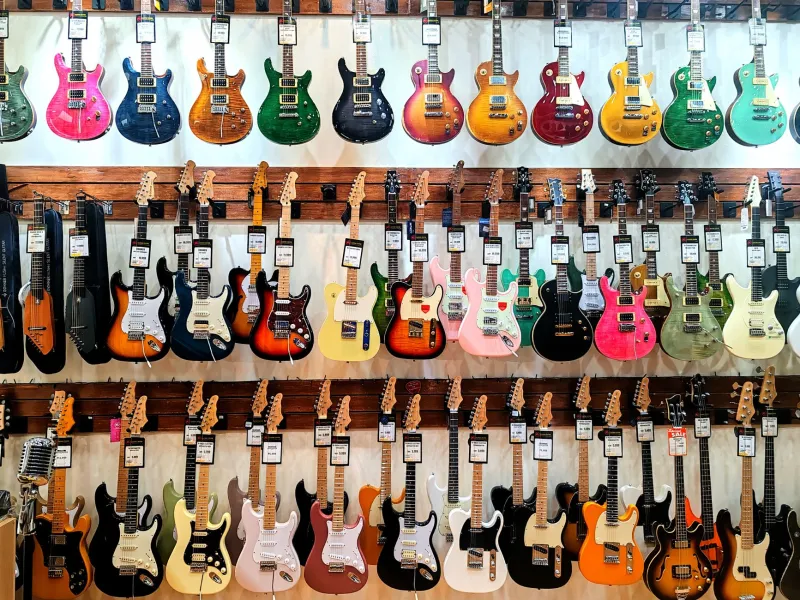
There's a version of this story that pretty much every musician knows. You start with one instrument. Then you pick up another because it seemed cool at a jam session. Then a third because it was on sale. Before long, your living room looks like the back room of a pawn shop, and somehow you feel less inspired than the day you owned nothing but a single acoustic guitar and a dream.
The problem isn't enthusiasm. Enthusiasm is great. The problem is that most players accumulate gear without any real framework for why one instrument complements another — or why two of them might just be stepping on each other's toes.
That framework exists. It's called frequency awareness, and once you understand it, the way you think about buying instruments will never be the same.
Every Instrument Has Its Own Lane
Sound is just vibration measured in cycles per second — hertz, if you want to get technical. The human ear picks up roughly 20 Hz on the low end to around 20,000 Hz on the high end. Every instrument you've ever heard lives somewhere inside that range, and most of them have a pretty specific home address.
A bass guitar, for example, is doing most of its heavy lifting between 40 Hz and 300 Hz. A standard acoustic guitar hangs out more in the 80 Hz to 5,000 Hz neighborhood, with its body resonance sitting in the midrange. A piano covers an enormous swath — nearly the full audible range — which is part of why it can feel like such a dominant force in any arrangement. A violin sits up high, typically shining between 200 Hz and 8,000 Hz. Cymbals and hi-hats live way up in the upper frequencies, sometimes pushing past 10,000 Hz.
None of this is just trivia. It's the foundation of smart instrument selection.
The Problem With "More Is More"
When you start adding instruments to your collection without thinking about frequency overlap, you end up with tools that fight each other rather than work together. This shows up in two ways.
First, there's the performance problem. If you're a solo artist or a small ensemble player, layering instruments that all live in the same frequency range creates sonic mud. You've heard this before — a mix where everything sounds vaguely loud but nothing sounds defined. That's what happens when a baritone ukulele, a rhythm guitar, and a keyboard pad are all competing for the same midrange real estate without anyone giving ground.
Second, there's the practice problem. When you own instruments that feel redundant — that serve roughly the same musical purpose — your attention gets split. You practice none of them as deeply as you would if you'd made one deliberate choice. Gear clutter breeds creative paralysis.
Start With Your Musical Vision, Not the Gear List
Before you add another instrument to your life, answer this question honestly: what kind of music do you actually want to make?
If your answer is "solo acoustic singer-songwriter stuff," then a quality acoustic guitar probably covers a huge percentage of your sonic needs. A capo, a loop pedal, and maybe a harmonica can add texture without redundancy. You don't need a full keyboard rig on top of that unless you're actively writing parts that require it.
If you're building a home recording setup and want to produce full-sounding tracks, then thinking about frequency coverage becomes a genuine creative strategy. You want something handling the low end (bass guitar, synth bass, upright bass — pick your flavor), something in the mids and upper mids (guitar, keys, or both if they're serving different roles), and something adding air and sparkle up top (acoustic guitar fingerpicking, a bright synth pad, auxiliary percussion).
The goal is complementary coverage, not duplication.
Practical Questions to Ask Before You Buy
Next time you're eyeing a new instrument — whether it's in a store, on a website, or in a Craigslist listing at 11 p.m. when your judgment is questionable — run through these:
Where does this instrument live in the frequency spectrum? Do a quick search if you're not sure. Most instruments have well-documented tonal ranges.
Do I already own something that covers this territory? If yes, what does the new instrument offer that's genuinely different? A different timbre? A different playing feel? A different cultural or stylistic identity? These can all be valid reasons — but be honest.
Does this fill a gap in what I'm trying to create, or does it just sound cool in isolation? Sounding cool in isolation is not nothing. But it's not a strategic reason to add to your collection if it doesn't serve the music you're actually making.
Can I commit to learning this properly, or will it become shelf furniture? An instrument you play badly in a frequency range you already have covered is doubly redundant.
When Overlap Actually Makes Sense
To be fair, frequency overlap isn't always the enemy. In some genres and contexts, it's intentional and effective.
Blues and rock bands often stack two or three guitars intentionally — one playing rhythm chords, one playing lead lines, maybe one handling a specific textural role. They're occupying similar frequency territory, but the playing roles are differentiated enough that it works. Jazz pianists and guitarists coexist in the same ensemble all the time, but they've developed decades of musical etiquette around voicings and space that keeps things from getting muddy.
The difference is intentionality. Those musicians understand the overlap and actively manage it. They're not just hoping it works out.
Building Smart From the Start
If you're earlier in your musical journey, the best gift you can give yourself is a deliberate, unhurried approach to building your instrument collection. Pick one instrument and go deep before you go wide. Understand what it does well, where it sits sonically, and what it genuinely can't do — that last part will tell you what you might legitimately need next.
When you do add something new, let it be because it opens a door your current setup can't open. A bassist adding a fretless for its distinctive vocal-like midrange quality. A keyboardist picking up a Rhodes because its warm, decaying attack is something a digital piano just doesn't replicate the same way. A guitarist grabbing a baritone to explore that darker, lower-register territory without fully stepping into bass playing.
Those are additions with purpose. That's curation, not accumulation.
At Shabach Music Shop, we're always happy to talk through what might actually complement what you're already playing — whether that's in our instrument section, a conversation with one of our lesson instructors, or just helping you think through what gap you're actually trying to fill. Because the best instrument you can own is the one that genuinely serves your sound — not just the one that looked irresistible on a Tuesday afternoon.
Your sound starts with clarity. Build from there.