Why Your Best Tone Is Killing the Band: The Truth About Frequency Masking
You've done everything right. Spent hours tweaking your amp's EQ, swapped out pickups, tried four different sets of strings, and landed on a tone that genuinely makes you stop and smile every time you play alone in your bedroom. It's warm, full, and rich — the kind of sound you'd pay good money to hear on a record.
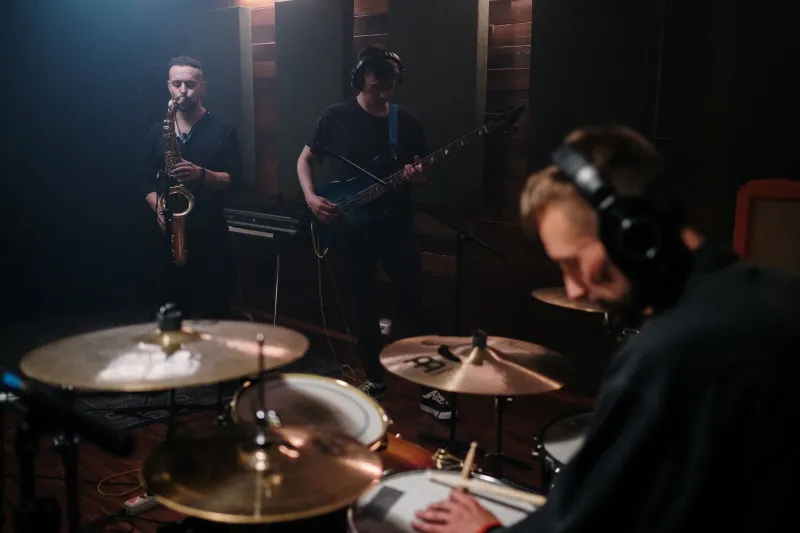
Then rehearsal happens. The drummer kicks in, the bassist locks in a groove, the keys player lays down a pad, and suddenly your gorgeous tone has completely disappeared. You turn up. Still gone. You roll back the reverb. Still gone. You start second-guessing every decision you've made since you bought your first instrument.
Here's the thing: your tone isn't bad. It's just not built for the situation you're putting it in.
What Frequency Masking Actually Means
Every instrument occupies a range of frequencies in the audio spectrum. Bass guitars and kick drums dominate the low end — roughly 60Hz to 250Hz. Snare drums and rhythm guitars tend to live in the midrange. Vocals and lead instruments fight for space in the upper mids. Cymbals and high-end shimmer fill out the top.
When two instruments share a significant chunk of the same frequency range, one of them tends to make the other harder to hear. That's frequency masking in a nutshell. It's not a gear failure — it's basic physics. When your guitar's low-mid warmth is sitting right on top of where the bass guitar peaks, your brain has trouble distinguishing one from the other. One instrument effectively drowns out the other, even if neither one is particularly loud.
The cruel irony is that the tones most prone to masking are often the ones that sound the best in isolation. A fat, warm, scooped guitar tone with heavy low-end presence sounds incredible when you're the only thing in the room. Put a bassist and a kick drum next to it, and that warmth turns into mud almost instantly.
Why Practice at Home Lies to You
Most musicians develop their tone in one context and perform in a completely different one. At home, you're the only sound source. Your ear fills in everything it wants to hear, and your brain interprets the fullness of your tone as a feature. In a band setting, that same fullness is competing with five other full sounds, and the whole thing collapses into a wall of indistinguishable noise.
This is why so many gigging musicians — especially guitarists — eventually land on tones that seem almost too thin or bright when heard alone. A guitar dialed in with a slight upper-mid boost and a tighter low end might feel kind of harsh sitting by itself. But the moment the full band comes in, it carves out a clear space in the mix that lets every note ring through without fighting anyone else.
The same principle applies across instruments. A keyboard pad that sounds beautifully lush in isolation can completely bury a vocal. A bass tone with a ton of low-mid presence can cloud up the entire bottom of a mix. Even drum tuning affects this — a boomy kick drum tuned for feel in the practice room can make the whole band sound muddy on stage.
Rethinking How You Dial In Your Sound
The fix isn't complicated, but it does require a shift in mindset. Instead of optimizing your tone for how it sounds alone, you need to start optimizing it for how it fits alongside everything else.
Start with the full band present. Whenever possible, dial in your sound during rehearsal rather than at home. What your instrument needs to do in a full mix is genuinely different from what sounds good in a bedroom. Don't finalize any EQ settings until you've heard them compete with a kick drum, a bass, and at least one other harmonic instrument.
Learn where your instrument lives in the spectrum. Guitars typically own the 1kHz–5kHz range for presence and cut. Bass guitars anchor the 80Hz–300Hz zone. If you're a guitarist piling on low-end warmth, you're not adding body — you're stepping on your bassist's territory. Cut where another instrument already dominates, and boost where there's actually room to breathe.
Use a high-pass filter more aggressively than you think you should. This is one of the most underused tools in a live or recording context. Rolling off everything below 100Hz on a guitar signal doesn't make the guitar sound thin — it makes the bass and kick sound clearer, which in turn makes the whole mix sound bigger. The guitar still sounds full because the rest of the band fills in those low frequencies.
Consider how you sit in the mix, not just how you sound. Ask yourself: can the vocalist hear themselves? Can the bassist feel their own notes? If your instrument is making it harder for the people around you to hear themselves, your tone is working against the music — even if it sounds great to you.
The Gear Side of the Equation
Some instruments and setups are naturally better at cutting through a mix than others. Single-coil pickups tend to have a natural presence in the upper mids that helps them project through dense arrangements. Humbucker-equipped guitars often require a little more intentional EQ work to keep the low mids from piling up. Smaller amplifiers — particularly ones that don't have a lot of low-end headroom — can actually be more mix-friendly in certain live contexts because they don't add unnecessary bottom-end weight.
For bass players, the classic advice about blending a clean DI signal with your amp tone exists for exactly this reason. The DI captures clarity and definition; the amp adds body and character. Together, they give you a bass sound that's felt and heard.
For keyboardists and synth players, this is where layering and frequency awareness become an art form. A pad that occupies the entire spectrum sounds massive alone and suffocating in a band context. Learning to automate the low end out of your pads — or choosing sounds that naturally sit in a narrower range — can transform how your whole band sounds without anyone changing their instrument.
The Bigger Lesson
Chasing tone in isolation is a perfectly valid part of the creative process. Playing around with sounds, discovering what resonates with you, and developing your own sonic identity all happen in private moments between you and your instrument. That part of the journey matters.
But at some point, the music you're making stops being just about you and starts being about something larger — a band, a recording, a performance. When that shift happens, the definition of "great tone" changes with it. Great tone in a band context isn't the most beautiful sound in the room. It's the sound that makes the whole band sound better.
That's the real skill. And honestly? It's a lot more interesting than tweaking EQ knobs alone in your bedroom.