Empty Space Is Your Instrument: How Learning to Rest Changed Everything for the Greats

There's a moment in Miles Davis's Kind of Blue — specifically in "So What" — where the trumpet just stops. Not because Miles ran out of ideas. Not because the band fumbled. The silence is deliberate, weighted, and somehow louder than anything that came before it. If you've ever felt that pause in your chest before the phrase resolves, you already understand what this article is about.
Most musicians, especially early on, treat silence like a problem to solve. There's a reflexive urge to fill every bar, every beat, every breath with something. A run here, a chord stab there. And honestly? That instinct makes sense. You've spent years learning how to play. But at some point, the real growth starts happening when you learn how to not play.
Why We're Wired to Overfill
Blame the streaming era if you want, but the tendency to cram music full of sound goes way back. In live settings, silence can feel like failure — like you dropped the ball or forgot your part. In the studio, it's tempting to layer track after track until every frequency is occupied. We've been culturally conditioned to equate density with quality.
But listen to the records that have stood the test of time. The ones people still put on at 2 a.m. when something big is happening in their lives. Those recordings breathe. They have space. The arrangement isn't fighting itself for your attention.
Producer Rick Rubin has talked extensively about stripping things away — removing elements until only what's essential remains. It sounds simple, but it takes genuine confidence to sit inside a sparse arrangement and trust that the silence is doing its job.
The Physics of Musical Tension
Here's something worth understanding on a technical level: sound only has meaning in relation to its surroundings. A note doesn't exist in isolation — it exists in contrast to what came before it and what comes after. When you remove sound entirely, even briefly, you reset the listener's expectation. You create anticipation. And anticipation is what makes a resolution feel satisfying.
Think about the drum drop in any well-produced hip-hop track. The beat cuts out for a measure, and when it comes back in, it hits exponentially harder than if it had just kept rolling. That's not accident. That's a producer who understands negative space as a compositional tool.
The same principle applies to a guitar solo, a piano ballad, a bass groove — any instrument in any genre. The rest isn't an absence of music. It's an active, intentional part of the composition.
What Legendary Performers Actually Do
Beyond Miles Davis, look at how B.B. King played. He was famous for saying he could say more with one note than most guitarists could say with twenty. Watch footage of him performing and you'll notice something striking — there are long stretches where he's not playing at all. He's letting the previous phrase hang in the air, letting the audience feel it before he continues.
In a completely different genre, Billie Eilish's early recordings with her brother Finneas are masterclasses in sparse production. Songs like "when the party's over" use silence and near-silence to create an intimacy that a fully produced track never could. You feel like you're in the room with her. That feeling comes directly from space in the arrangement.
Even in heavier music, bands like Tool use odd time signatures and unexpected rests to build tension that makes the heavy parts hit harder. Drummer Danny Carey isn't just playing grooves — he's sculpting time, and that includes deciding when not to hit.
How to Actually Practice This
Okay, so you're sold on the concept. Now what? Here are some concrete ways to start working silence into your playing.
Record yourself and listen back. This is the fastest way to hear your own over-playing. Record a simple improvisation, then listen. Mark every moment where you felt the urge to add something but didn't need to. You'll start recognizing the patterns.
Play to a click and leave full bars empty. Set a metronome, start a simple progression, and challenge yourself to leave entire measures completely silent. It'll feel wrong at first. That discomfort is the lesson.
Study arrangements you love. Pick three songs that genuinely move you and listen specifically for the spaces. Where does the arrangement open up? What gets removed before a big moment? What's NOT there that makes the moment land?
Limit your note count. Give yourself a challenge: improvise for two minutes using no more than 20 notes total. You'll be forced to make each one count, and you'll naturally incorporate more space.
Play with dynamics alongside silence. Silence isn't just about full stops. It's also about playing softer, pulling back the attack, letting a note decay instead of filling the gap. Explore the full range between your loudest and quietest playing.
The Emotional Argument
Beyond the technical, there's something deeply human about musical space. We process emotion in pauses. Think about how a skilled actor uses silence in a scene — the beat before they respond, the held breath before they speak. Music works the same way.
When you leave space in your playing, you're inviting the listener in. You're giving them room to project their own feeling onto the music. A relentlessly busy arrangement tells the listener exactly how to feel. A spacious one lets them feel it themselves. That's the difference between music that's impressive and music that's personal.
Gear Can Help, But It Starts With You
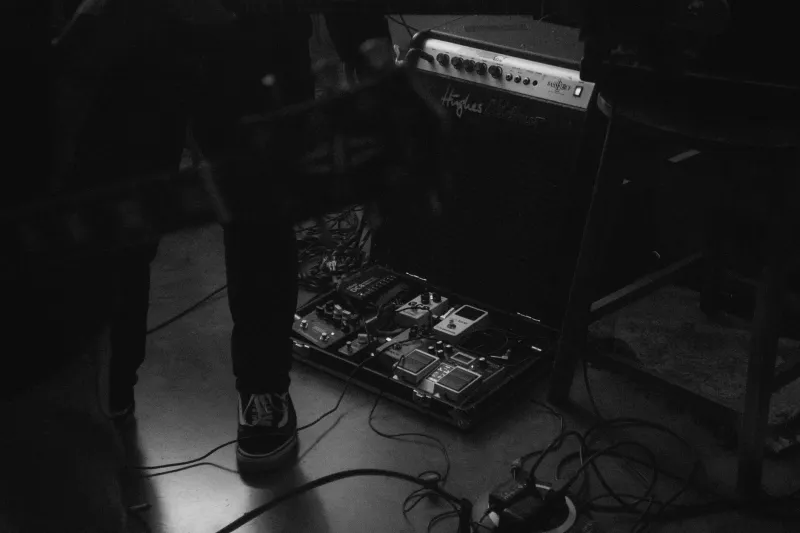
Some tools can support this journey. A good volume pedal lets you swell in and out of notes, creating natural breathing room. A looper pedal is fantastic for practicing space — set a loop, then improvise over it with the explicit goal of playing less. Even a simple reverb unit can help you hear how a single note fills a room when you give it space to develop.
But ultimately, no piece of gear teaches you restraint. That's a mental shift. It's choosing, in the moment, to trust the silence.
The best musicians in any genre — jazz, blues, country, hip-hop, classical — have all figured this out. The notes you play define your technique. The space you leave defines your voice.
So the next time you sit down to practice, try putting down the riff for a minute. Let the last note ring out. Let the room breathe. See what happens when you stop filling every moment and start shaping the silence instead.
You might surprise yourself with what you find there.