Dots and Lines: The Case for Learning to Read Music in an Age of Loops and Plugins
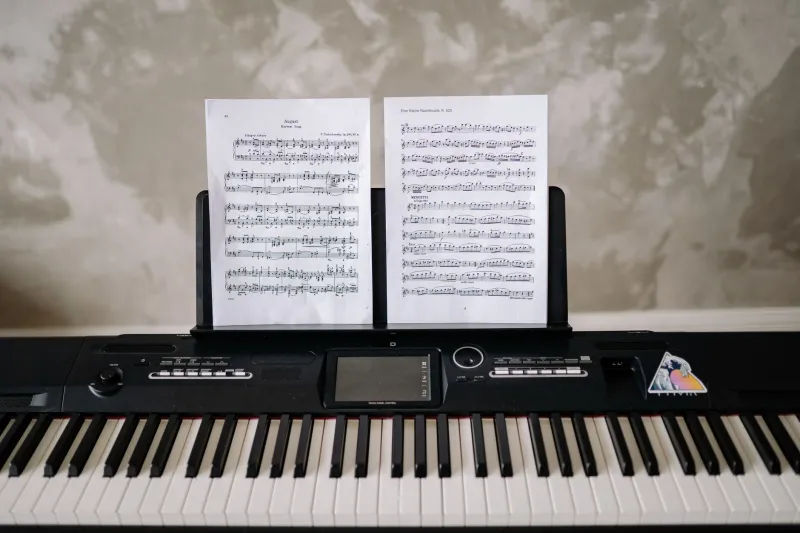
Let's be honest — if you learned guitar or bass in the last decade or so, there's a solid chance you've never seriously sat down with a piece of sheet music. Why would you? Tabs are everywhere. YouTube tutorials are free and endlessly patient. DAWs like GarageBand, Ableton, and Logic have made it easier than ever to produce, record, and even compose music without ever glancing at a treble clef. And honestly? That's kind of incredible.
But somewhere along the way, a generation of genuinely talented musicians ended up with a gap in their toolkit — one that doesn't show up until it really matters. If you've ever felt a little lost in a rehearsal when someone passed around a lead sheet, or fumbled through a conversation about chord voicings with a classically trained player, you already know what that gap feels like.
So let's talk about why notation literacy still has serious value in 2024, and what you can actually do about it.
The Tab Trap (And Why It's Not Tab's Fault)
Tabs are fantastic. Nobody's here to bash them. They're visual, intuitive, and they get you playing real music fast — which matters a lot when you're just starting out and need wins to stay motivated.
The problem isn't tabs themselves. It's that they only tell you where to put your fingers. They don't tell you how long to hold a note, what the rhythmic feel should be, or how a phrase fits into the harmonic context of a song. You end up learning shapes without fully understanding the music underneath them.
DAWs have a similar effect. When you're dragging MIDI clips around a timeline and nudging notes in a piano roll, you're working visually and spatially — which is powerful — but you're not necessarily building a mental map of music theory that translates across instruments, genres, or collaborative settings.
Sheet music does all of that. It's a language, and once you speak it, everything else gets a little clearer.
The Collaboration Advantage Nobody Talks About
Here's a scenario that happens more than you'd think: you get called in to play on a recording session, join a new band, or sub in for someone at a church gig or community orchestra. The bandleader hands you a chart. Everyone else glances at it and starts playing. You're left trying to fake your way through it, hoping nobody notices.
That's an uncomfortable spot to be in, and it's completely avoidable.
Reading music opens up a whole tier of playing opportunities that are simply off the table otherwise — pit orchestras, session work, chamber ensembles, big bands, wedding bands with real charts, music education programs. These aren't niche situations. For a lot of working musicians across the US, this is the gig economy.
Even if you're not chasing those opportunities, being able to communicate with trained musicians in their native language is just... respectful. And it makes you more useful in any collaborative setting.
It Makes You a Better Theory Student (Without Trying)
One of the sneaky benefits of learning notation is how naturally it reinforces music theory. When you're reading a piece of music, you're constantly processing key signatures, time signatures, intervals, and rhythmic values — not as abstract concepts, but as real information you're applying in real time.
Players who learn this way tend to internalize theory faster than those who study it separately. The staff becomes a kind of visual map of the musical landscape, and once you can navigate it, concepts like chord inversions, modulations, and melodic contour start making intuitive sense.
If you've ever sat through a music theory class and felt like the ideas weren't quite sticking, adding notation practice to your routine might be the missing piece.
Starting From Zero as an Adult (It's Not as Hard as You Think)
Okay, here's where a lot of players tap out mentally. Reading music feels like learning a new language from scratch, and if you're already comfortable playing, it can feel weirdly humbling to be a beginner again at something music-related.
But here's the thing — you're not starting from zero. You already know how music sounds. You already have a feel for rhythm, phrasing, and dynamics. That's a massive head start. What you're really doing is learning to decode a system that describes something you already understand on a gut level.
A few practical ways to get moving:
Start with your instrument's natural range. If you play guitar, start with treble clef single-note melodies. If you play bass, dive into bass clef. Don't try to read everything at once — get comfortable with the range you actually use.
Use real music you already know. Find sheet music for songs you can already play by ear. Connecting the notation to sounds you recognize makes the learning click much faster than drilling abstract exercises.
Try a lesson or two. Seriously. Even a handful of sessions with a teacher at a local music shop — like the instructors here at Shabach — can compress weeks of confused self-study into a clear, structured path. Sometimes you just need someone to explain the logic once and it all falls into place.
Practice a little every day. Fifteen minutes of notation reading is more effective than a two-hour cram session on weekends. Your brain needs time to consolidate the patterns.
Use apps as a supplement. Tools like Musicca, Tenuto, or even Simply Piano can make note recognition feel more like a game than a chore. They won't replace real practice, but they're great for building speed and fluency.
Your DAW Actually Gets More Powerful When You Can Read
Here's something most people don't expect: learning notation makes you better at using a DAW, not worse.
When you understand rhythmic values, you make smarter decisions in your piano roll. When you understand key signatures and scales, you're less likely to write melodies that clash with your chord progressions. When you can read a lead sheet, you can transcribe ideas directly into your sessions with more precision and less guesswork.
The two skills aren't competing. They're complementary. The musicians who are most dangerous in a modern studio setting are the ones who can move fluidly between the analog and digital worlds — who can read a chart and then loop it in Ableton, who can compose on paper and then produce it in Logic.
The Bottom Line
Learning to read sheet music isn't about being old-fashioned. It's about being complete. In a music world that's more accessible than ever, the players who stand out are the ones who've done the work that most people skip.
You don't have to become a sight-reading machine overnight. You just have to start. Pick up a beginner notation book, grab some sheet music for a song you love, or book a lesson with someone who can show you the ropes. The investment is small. The payoff is real.
Your sound already starts here — make sure you can write it down too.