Better Together: The Musical Growth That Only Happens When You're Playing With Other People
Practice rooms are important. Headphone mixes are useful. YouTube tutorials have genuinely changed how people learn instruments. But there is a category of musical skill that you simply cannot develop alone, no matter how disciplined or dedicated your solo practice is.
Playing with other people is irreplaceable. And for a lot of musicians — especially those who've been grinding away in isolation — it's the missing piece they didn't even know they needed.
The Blind Spot Problem
When you practice alone, you are your own audience. And here's the thing about being your own audience: you fill in the gaps. You hear what you meant to play, not always what you actually played. You compensate for your own timing issues without realizing it. You've been playing that transition a certain way for so long that it doesn't even register as a problem anymore.
Other musicians don't fill in your gaps. They react to what you actually do.
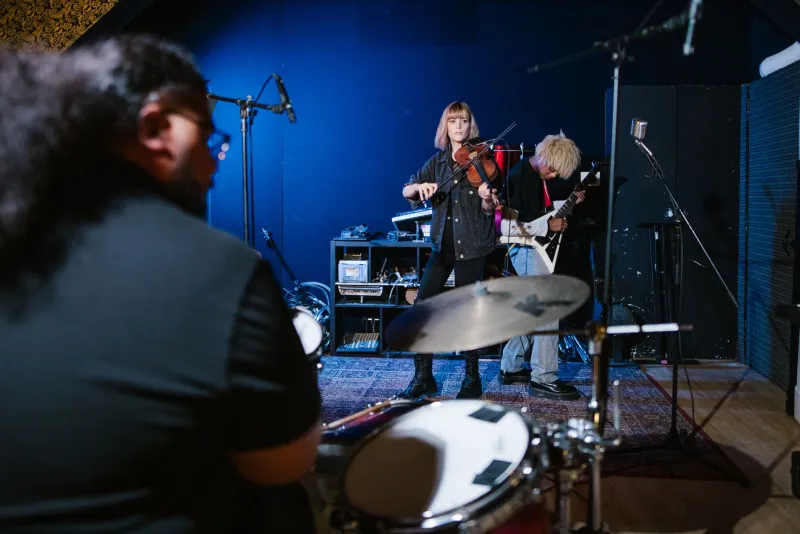
A drummer who rushes the snare on the backbeat will get away with it in a solo recording environment — they can fix it in the edit, or simply not notice it because there's no reference point. Put that same drummer in a room with a bassist, and the timing discrepancy becomes immediately obvious. Not because the bassist is judging them, but because the interaction itself creates a mirror.
This is one of the most powerful things about ensemble playing: the feedback is immediate, honest, and completely ego-neutral. The music either locks or it doesn't.
Adaptability Is a Skill You Can Only Train With People
Musical adaptability — the ability to respond to what's happening around you in real time — is one of the most important and underrated skills a player can develop. It's the difference between a musician who can execute their part and a musician who can play.
In a solo practice context, everything is under your control. The tempo is whatever you set it to. The dynamics are whatever you decide. The arrangement doesn't change unless you change it. That's a valuable environment for building technical skills, but it's a terrible environment for building adaptability.
Jam sessions, on the other hand, are almost entirely about adapting. The tempo drifts, and you have to decide whether to follow or anchor. Someone takes a solo in an unexpected direction, and the rhythm section has to respond. A vocalist changes the phrasing of a line, and the band has to catch it. These are micro-decisions happening in real time, and making them well requires a kind of musical intelligence that only gets developed through experience with other humans.
What Bandmates Teach You That Teachers Can't
A good teacher is invaluable. But a bandmate teaches you something different — something more lateral and unpredictable. They show you how they approach a problem, and that perspective can completely reframe how you think about your own playing.
Say you've been playing rhythm guitar in a straightforward, chordal way for years. You join a band with a keyboardist who naturally occupies a lot of the mid-range harmonic space. Suddenly your instinct to strum full chords is creating mud. You're forced to adapt — maybe you start playing more single-note lines, or higher voicings, or rhythmic stabs instead of sustained chords. That adaptation teaches you more about arrangement and frequency awareness than almost any lesson could, because it's driven by actual need.
Or consider the guitarist who has always played with a heavy pick attack. They start playing acoustic sets with a fingerpicker who plays very quietly, and they realize for the first time that their touch dynamics are underdeveloped. That discovery happens because of the collaboration, not despite it.
Jam Sessions: Underrated, Underused, and Everywhere
If you're not currently playing with other people regularly, jam sessions are the lowest-barrier way to start. They're everywhere — open mics, local music shops (yes, places like Shabach often host or know about local jams), community music programs, and online platforms like JamKazam or Jammr that let you play with musicians remotely.
The beauty of a jam session is that there are no stakes. Nobody's reputation is on the line. You're just playing, and in that low-pressure environment, you can take risks you wouldn't take in a rehearsal or a performance. You can try a new approach to a chord change, explore an unfamiliar style, or just lock into a groove and see where it goes.
Regular jam participants consistently report improvements in ear training, timing, dynamic control, and overall musical confidence — not because anyone was specifically teaching those things, but because the environment demanded them.
Finding and Keeping Creative Partnerships
The hardest part for a lot of musicians isn't recognizing the value of collaboration — it's actually finding and maintaining it. A few practical thoughts:
Start local and stay humble. The best collaborators aren't always the most technically impressive players. Look for people who listen well, show up reliably, and bring energy to the room. Those qualities matter more than chops, especially early on.
Use the tools available. Bandmix, Facebook musician groups, Craigslist music sections, and local music store bulletin boards are all legitimate ways to find players. Don't underestimate the power of just asking at your local shop — someone there usually knows who's looking.
Communicate about expectations. A lot of musical partnerships fall apart not because of musical differences, but because of mismatched expectations around commitment, direction, and goals. Have that conversation early.
Record your sessions. Even a simple phone recording of a jam or rehearsal gives you something to review later. You'll catch things you missed in the moment, and over time you'll be able to track your growth in ways that are genuinely motivating.
The Music You Can't Make Alone
There's a specific kind of musical moment that only happens between people — the locked groove where the band is playing as one organism, or the spontaneous call-and-response that neither player planned. Those moments are why musicians keep coming back to playing together, even when it's logistically complicated and sometimes frustrating.
Solo practice builds the foundation. Collaboration builds the musician. Both are necessary, but if you've been heavy on one and light on the other, you already know which one needs more attention.
Get in a room with other players. Your sound will never be the same.